Bladder urgency, frequent bathroom trips, nighttime waking and recurring urinary discomfort are common, especially after pregnancy and around menopause. FemiCore is one of a growing number of supplements built around the urinary and vaginal microbiome, pairing botanicals with Lactobacillus probiotics. This guide goes through every ingredient on the label, what it's meant to do and how strong the evidence is.
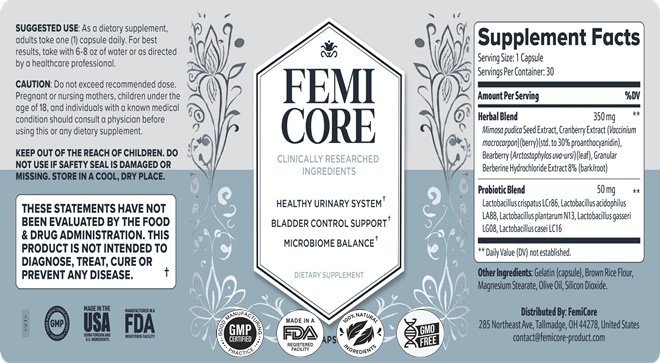
At a glance: each capsule contains a 350 mg herbal blend (mimosa pudica seed, cranberry standardized to 30% PACs, bearberry leaf and berberine HCl extract) and a 50 mg probiotic blend of five named Lactobacillus strains. Both are proprietary blends, so the amount of each individual ingredient isn't disclosed.
FemiCore supplement facts
| Component | Amount per capsule | Ingredients |
|---|---|---|
| Herbal blend | 350 mg (proprietary) | Mimosa pudica seed extract, cranberry extract (Vaccinium macrocarpon, 30% PACs), bearberry leaf (Arctostaphylos uva-ursi), berberine HCl extract (8%) |
| Probiotic blend | 50 mg (proprietary) | L. crispatus LC86, L. acidophilus LA88, L. plantarum N13, L. gasseri LG08, L. casei LC16 |
| Other ingredients | – | Gelatin (capsule), brown rice flour, magnesium stearate, olive oil, silicon dioxide |
| Serving | 1 capsule a day; 30 capsules per bottle | |
Why the proprietary blend matters: the label gives only the total for each blend, not for each ingredient. That means you can't check whether, for example, the cranberry dose matches amounts used in research. The probiotic blend is also listed by weight (mg) rather than by live bacteria count (CFU), which is the usual measure of a probiotic's strength. If these details matter to you, ask the vendor for them before buying.
The herbal blend (350 mg)
Cranberry extract (standardized to 30% PACs)
Cranberry is the best-known natural ingredient for urinary health. What matters most in research is its content of proanthocyanidins (PACs), compounds studied for making it harder for certain bacteria, including E. coli, to stick to the lining of the urinary tract. FemiCore uses an extract standardized to 30% PACs rather than plain cranberry powder, which is a sensible choice.
Evidence: the strongest in the formula. A 2023 Cochrane review found cranberry products were linked to fewer repeat symptomatic urinary tract infections in some groups, including women with a history of them. What's unknown is whether FemiCore's undisclosed amount reaches the doses used in those studies.
Bearberry leaf (uva ursi)
Bearberry has a long history in European herbal medicine for urinary comfort. Its main compound, arbutin, is converted in the body to hydroquinone, which acts in the urinary tract.
Evidence: recognized in European herbal guidance as a traditional remedy for short-term relief of mild lower urinary tract symptoms, based on long-standing use rather than strong clinical trials.
Caution: that same guidance limits use to short courses of about a week, a few times a year, and advises against use in pregnancy, breastfeeding and kidney disease. This sits awkwardly in a product designed for daily, long-term use. See FemiCore side effects.
Berberine HCl extract (8%)
Berberine is a compound found in plants such as barberry and goldenseal. It's widely studied for blood sugar and metabolic health, and has shown antimicrobial activity in laboratory studies.
Evidence: early for bladder health. Most bladder-related findings come from lab or animal work, not from studies in women with urinary symptoms. Because the label lists an 8% extract inside a shared blend, the actual amount of berberine per capsule is likely small, but it can't be calculated.
Caution: berberine can lower blood sugar and interact with many prescription drugs, and it shouldn't be used during pregnancy or breastfeeding.
Mimosa pudica seed extract
Mimosa pudica is a plant used in traditional medicine and often marketed for gut support. In FemiCore it's positioned as support for the gut side of the gut–vaginal connection.
Evidence: very limited. Research is mostly laboratory work on antimicrobial and antioxidant activity; there are few human studies of any kind.
The five probiotic strains (50 mg)
Unlike many supplements that list only a generic "probiotic blend", FemiCore names a strain code for each organism. That's good practice, because probiotic effects can differ between strains of the same species. The flip side: most published urinary and vaginal health research uses other strains, so results from those studies can't be assumed to apply to these exact ones.
Lactobacillus crispatus LC86
The species that most often dominates a healthy vaginal microbiome. It produces lactic acid, helping to keep the vaginal environment acidic, and lower levels have been observed in women prone to urinary and vaginal imbalance. Its most cited trial for urinary health used a vaginally applied product rather than an oral capsule.
Lactobacillus acidophilus LA88
One of the most widely used probiotic species, common in both digestive and women's formulas. It's included for general support of a balanced gut and urogenital microbiome.
Lactobacillus plantarum N13
A hardy species known for tolerating stomach acid relatively well, which may help more bacteria survive digestion. It's widely used in probiotic products for gut and general microbiome support.
Lactobacillus gasseri LG08
Another species naturally found in a healthy vaginal microbiome, alongside L. crispatus. It's included to support the overall balance of lactic-acid-producing bacteria.
Lactobacillus casei LC16
A common probiotic species studied mainly for digestive and immune support. In FemiCore it rounds out the blend's gut-focused side.
Other ingredients
Besides the active blends, each capsule contains gelatin (the capsule shell), brown rice flour, magnesium stearate, olive oil and silicon dioxide. These are standard fillers and flow agents. Because the capsule is made of gelatin, FemiCore isn't suitable for vegans or vegetarians.
How FemiCore's ingredients are meant to work together
The formula's idea is a two-part approach: the Lactobacillus strains support the beneficial bacteria of a healthy urogenital microbiome, while the botanicals, cranberry PACs above all, support the urinary tract lining. Berberine and mimosa pudica are added for broader microbial and gut support.
It's a reasonable concept, but it hasn't been tested as a combination: no clinical trial of FemiCore itself has been published. There's also a possible tension inside the formula, since bearberry's activity is thought to depend on urine chemistry that cranberry may work against. And no supplement strengthens the pelvic floor muscles, which are the main issue in leaks caused by coughing, sneezing or lifting.
Want to see the current packages and the 60-day guarantee terms?
Check FemiCore priceAffiliate link. Prices are set by the vendor; confirm them at checkout.Evidence summary by ingredient
| Ingredient | Intended role | Evidence strength |
|---|---|---|
| Cranberry (30% PACs) | Urinary tract lining support | Moderate |
| L. crispatus | Vaginal and urinary microbiome | Limited to moderate (mostly vaginal use) |
| L. gasseri, L. acidophilus, L. plantarum, L. casei | Microbiome and gut support | Limited for urinary health |
| Bearberry | Short-term urinary comfort | Traditional use |
| Berberine | Microbial support | Early (lab and animal) |
| Mimosa pudica seed | Gut support | Very limited |
For how these findings add up to an overall verdict, read our full FemiCore review.
Ingredient safety at a glance
- Pregnancy and breastfeeding: avoid, mainly because of berberine and bearberry.
- Medications: berberine can interact with diabetes medicines and drugs processed by the liver; cranberry has been reported to affect warfarin.
- Long-term use: discuss with your doctor because of bearberry.
- Weakened immune system: ask a doctor before taking any probiotic.
- Diet: the gelatin capsule isn't vegan or vegetarian.
Full details are in FemiCore side effects and drug interactions, and dosing tips are in how to take FemiCore.
Frequently asked questions
What are the ingredients in FemiCore?
Each capsule contains a 350 mg herbal blend of mimosa pudica seed extract, cranberry extract standardized to 30% PACs, bearberry leaf and berberine HCl extract, plus a 50 mg probiotic blend of L. crispatus LC86, L. acidophilus LA88, L. plantarum N13, L. gasseri LG08 and L. casei LC16.
How much of each ingredient is in FemiCore?
The label lists only blend totals: 350 mg for the herbal blend and 50 mg for the probiotic blend. Individual ingredient amounts and the probiotic CFU count aren't disclosed.
Is FemiCore vegan?
No. The capsule is made of gelatin, so FemiCore isn't suitable for vegans or vegetarians.
Which FemiCore ingredient has the most research?
Cranberry extract standardized to PACs has the strongest evidence, followed by L. crispatus, although its best-known urinary trial used a vaginal product rather than an oral capsule.